

SRL - Information
An SRL is a limited liability company. In practice, it is a company separate from you as a private individual, with its own CUI, registered office, bank account, administrator, shareholders, CAEN activities and tax obligations.
For a game developer, an SRL becomes useful when the activity starts to look like a business: you publish games, sign contracts, work with publishers, pay collaborators, buy services, get paid from platforms, or you want the game's IP to belong to the company, not just to you personally.
What "limited liability" means
The basic idea is that the company answers with its own assets, not directly with everything you own personally. This does not mean the administrator can do anything without consequences, but it draws a clearer line between the company's risk and your personal life.
For games, this matters most when contracts, payment obligations, collaborators, publishers, licenses, assets, disputes or larger revenues come into play.
What information an SRL has
An SRL has a few details you will use constantly in forms, contracts and platforms:
- the full company name;
- CUI / tax code;
- Trade Register registration number;
- registered office;
- administrator;
- shareholders;
- main CAEN code and secondary codes (see CAEN Codes);
- bank account / IBAN (see Bank account);
- VAT status, if applicable (see European VAT number);
- beneficial owner;
- articles of association (see Document templates);
- registration certificate (see Documents issued);
- certificate of registered details (certificat constatator) (see Documents issued).
It is worth keeping them all in one place, because you will copy them often into Steam, Apple, Google, banks, contracts, invoices and online services. On this platform you can centralize them in My Own Company Details, where you copy them with one click.
How to verify a company
When you want to verify an SRL, yours or someone else's, start with official sources.
On the Ministry of Finance website you can check identification data, tax information, VAT, balance sheets from recent years and any outstanding debts to the state budget. You can search by CUI or by name and county. It is handy for a quick check on a future collaborator.
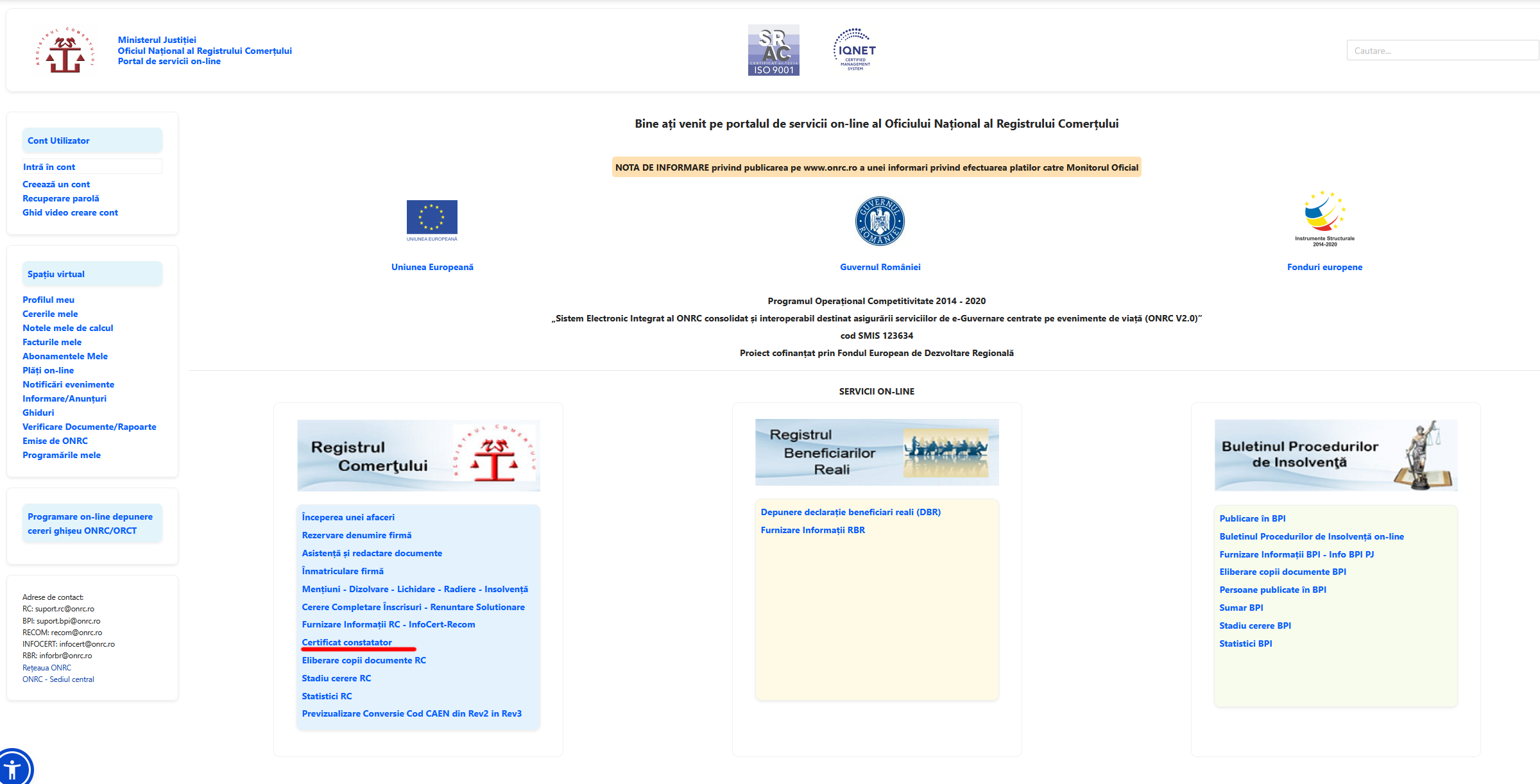
On the ONRC portal you can use services such as information from the Trade Register, the certificate of registered details, document copies, request status and other company-related services.
Sites like ListaFirme, DateFirma or similar directories can be useful for a quick look (the link above is an example of a company page), but ideally you should confirm the important details from official sources, especially before contracts, payments or serious decisions.
What to check before a contract
Before you sign with a company, check at least the basics:
- the company exists and is active;
- the CUI and name are correct;
- the administrator or the person signing has the right to represent the company;
- the activity object makes sense for the services discussed;
- the company does not appear struck off, dissolved, insolvent or with obvious problems;
- the data in the contract matches the data in official sources;
- the bank account belongs to the company or is clearly justified in the contract.
For large collaborations, publishers, investments or significant amounts, ask for a recent certificate of registered details and talk to a lawyer or accountant.
What the certificate of registered details is
The certificate of registered details (certificat constatator) is one of the company's most important documents. It shows the company's situation at a given moment: name, registered office, CUI, administrators, shareholders, activity object, work points and other official information.
You will run into it often at banks, contracts, grants, publishers, business checks or platforms that ask for proof that the company exists. See what it looks like in Documents issued.
You can get it online from the ONRC portal, straight from your account, without going to a counter.
What the articles of association are
The articles of association (actul constitutiv) are the SRL's foundational document. They set out the company's main rules: who the shareholders are, who runs the company, where the office is, what CAEN activities it has, how the share capital is split and how the company works.
For a game studio, the articles of association matter most when you have several shareholders, when you want to change CAEN codes, when you work with publishers, or when you want the company to clearly own the activity and the IP. You can find a template at SRL incorporation document templates.
What the share capital is
The share capital is the amount or value the company starts with. It is not the same as the real money you will invest in the game, marketing, team or operations.
Minimum share capital: 500 lei. In 2026, the minimum share capital for an SRL is indicated by ONRC as 500 lei. Always check the current value before incorporation, because the rules can change.
What you should know as a game developer
An SRL is usually the better choice if you want to build a studio, not just invoice your own personal work.
It fits better for:
- games published under a studio brand;
- IP owned by the company;
- cofounders and ownership percentages;
- employees and collaborators;
- publisher contracts;
- investments;
- grants;
- B2B services;
- larger revenues and recurring operations.
You do not need an SRL just because you publish on Steam, Google, Apple or itch.io. These platforms can work with other legal forms too, depending on the case. The difference is that an SRL gives a cleaner structure for business, contracts, risk, ownership and growth.
If you are still between options, see SRL vs PFA and the income calculator.
Things worth keeping organized
Once you have the SRL, save in a safe place:
- the registration certificate;
- the certificate of registered details;
- the articles of association;
- the CUI;
- the Trade Register order number;
- the company IBANs;
- the administrator's details;
- the CAEN codes;
- the VAT data, if any;
- the digital signature;
- the platform accounts;
- the login details for ANAF / SPV / e-Factura;
- the important contracts.
For that, see also the My Own Company Details page, where you can centralize the information you will use constantly in forms.