

European VAT number
When you set up an SRL, the company gets a CUI (its unique identification code), you use it in contracts, invoices, banking and on platforms. At the start, many companies are not VAT-registered: they have a CUI, but no VAT code with the RO prefix.
The biggest confusion: a "VAT code" is not the same as a "CUI". The VAT code (RO…) coincides with RO + CUI only when you are a normal VAT payer. For a special intra-community code (art. 317) it can be a different number. Always check it on the VAT certificate or in VIES; don't assume it.
CUI vs VAT code
| Plain CUI | VAT code | |
|---|---|---|
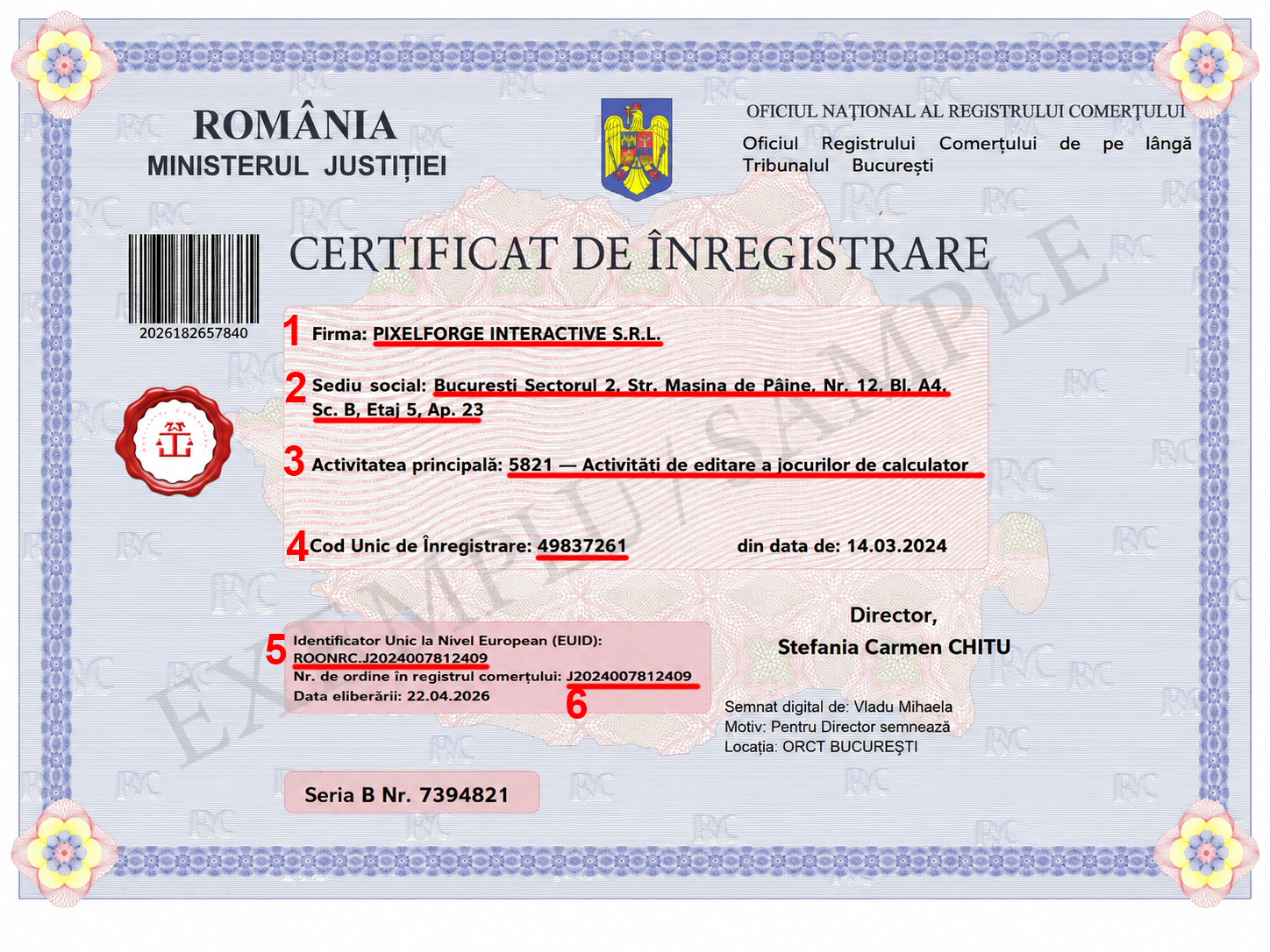
| Example | 49837261 |
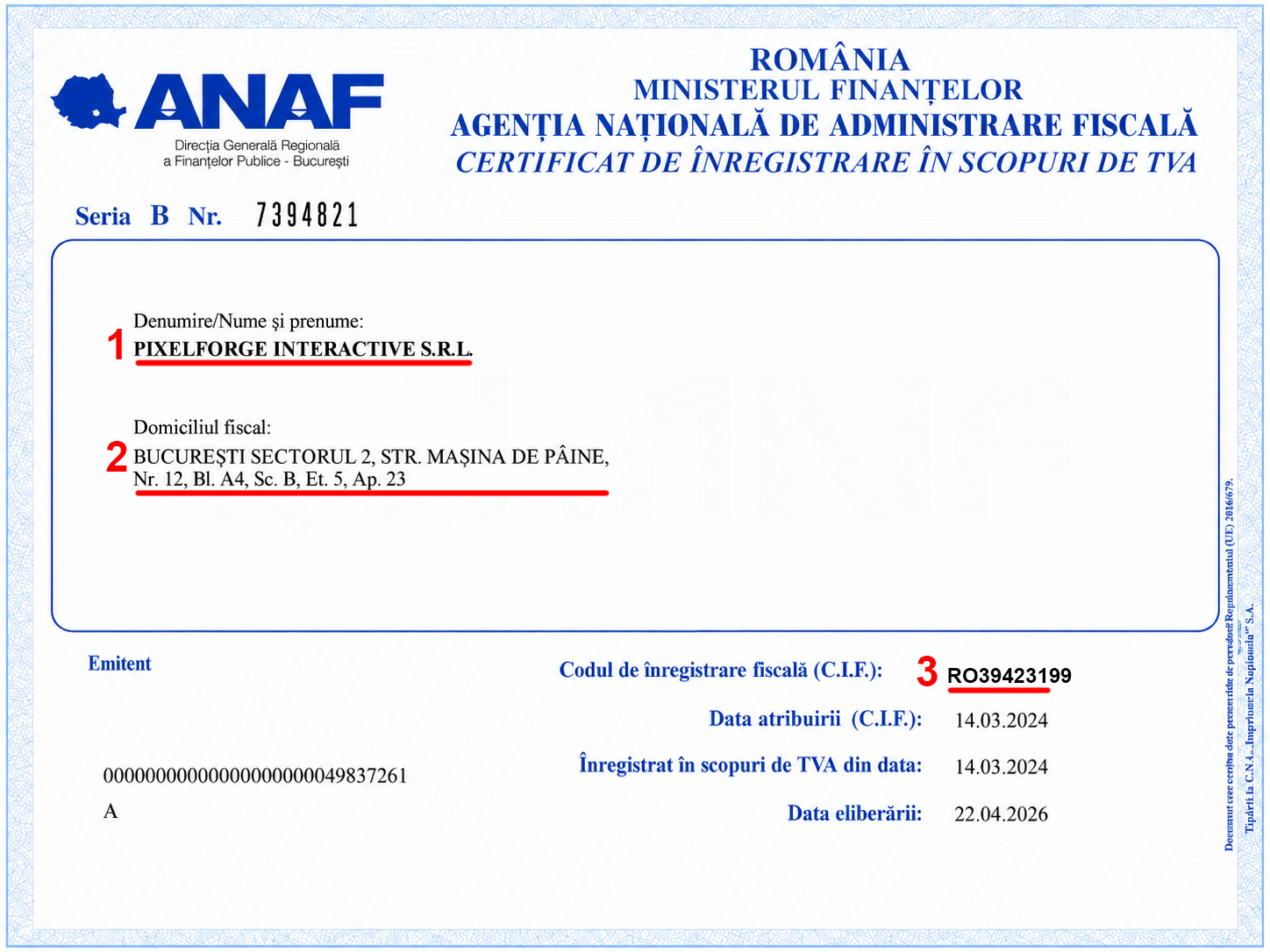
RO39423199 |
| What it's for | identifies the company in Romania | VAT, verifiable in VIES |
| Do you have it from the start? | yes, at incorporation | no, only after VAT registration |
The same company, two documents: the registration certificate shows the plain CUI, the VAT certificate shows the code with RO.
The three situations
| Situation | What the code looks like | What it means |
|---|---|---|
| Not VAT-registered, no European code | 49837261 (CUI, no RO) |
The company exists, but has no code for intra-community operations. |
| Not VAT-registered, with a special code (art. 317) | RO + digits, possibly different from the CUI |
You stay non-VAT in Romania, but have a code for EU operations. |
| Normal VAT payer (art. 316) | RO + CUI, same digits |
You collect and deduct VAT under the normal regime. |
Concrete examples (game dev)
What applies in typical situations for a small studio:
| Your situation | Do you need a VAT code? | What you do |
|---|---|---|
| New SRL, you only receive payouts from Steam / Apple / Google | Usually not for the payout, but the platform may ask for a VAT ID at setup | Have your CUI ready; ask your accountant if the platform needs an intra-community code |
| You pay for EU services (Unity, hosting, ads from another EU country) | Yes, intra-community code (art. 317) | The accountant files D700 before the first EU invoice |
| You supply services to an EU company | Yes, intra-community code (art. 317) | Same, get the code beforehand |
| You exceed 395,000 lei revenue/year | Yes, you become a normal VAT payer (art. 316) | The accountant handles the VAT file |
Ask your accountant: "The company is not VAT-registered. Do we need an intra-community VAT code (art. 317) for Apple / Google / EU services? If so, can you file D700?"
art. 317 vs art. 316
| Intra-community code (art. 317) | Normal VAT payer (art. 316) | |
|---|---|---|
| Purpose | EU operations (services received/supplied) | normal VAT regime |
| Do you pay VAT in Romania? | no, you stay non-VAT | yes, you collect and deduct |
| Declarations | minimal, tied to EU operations | periodic VAT returns |
| In VIES | yes, RO + digits (possibly ≠ CUI) |
yes, RO + CUI |
The 395,000 lei threshold
From 2025, the VAT exemption threshold rose from 300,000 to 395,000 lei/year. Below it you can stay non-VAT; once you exceed it, you register as a normal VAT payer (art. 316), and the accounting gets more complex (VAT returns, collected/deductible records).
The rule is stricter now: the normal regime can apply from the day you exceed the threshold, not from the end of the month. If you're getting close, talk to your accountant early.
Why it matters for platforms
EU platforms and services, Apple App Store, Google Play, Steam, advertising, hosting, SaaS, may ask for a VAT ID at onboarding. It's much cleaner to have the code ready before you get stuck in a form:
- non-VAT → intra-community code (art. 317);
- VAT payer → the normal VAT code.
Save your CUI and (if you have it) your VAT code in My company details, so you can paste them quickly into forms.
In short
- CUI ≠ VAT code automatically.
- You work with EU services/companies and you're non-VAT → intra-community code (art. 317).
- You exceed 395,000 lei/year → normal VAT payer (art. 316).
- The VAT files are handled by your accountant.
Check a code in VIES; the forms (including D700) are on the ANAF portal. The rules change often, always confirm the procedure with your accountant.